i’ve gotten a few responses here asking for some clarification on this paper and why making essentially squishy plants was important enough to make it into the plant science section of nature, one of the most influential journals in the world, and i’d be happy to oblige and break this down a little!!
so to start off, plants have two kinds of membranes around their cells, while animals only have one. one of these is called the ‘plasma membrane’, which is a soft, squishy kind of membrane that we have as animals that just kind of holds everything in. the other kind that only plants have is called a ‘cell wall’, which in plant cells surrounds the plasma membrane to basically hold everything in even more, and is really rigid and hard instead of squishy. the cell wall is made of a strong substance called ‘cellulose’, which you prob have heard of before, which acts as a really strong support structure to hold up the plant and protect the cells. the cell wall has a lot of different functions, but one of the main ones is structural; the pressure between the cell wall and the water inside the plant’s plasma membrane forming ‘turgor pressure’, which keeps the plant upright (when a plant needs water, it’s turgor pressure goes down, and there isn’t enough water in the cells to push against the cell wall to hold it upright. this is what causes wilting!)
now here’s the problem with cellulose: it’s a BITCH to break down. in settings where people are trying to make biofuels and renewable oils from algae and plant materials (and being successful in limited amounts!!), cellulose is the biggest thing keeping the process from higher efficiency, making it harder for those techniques to keep up with fossil fuels. but removing the cell wall altogether wacks out the plant’s turgor pressure, upon which a TON of natural processes and biological functions in plants are based (turns out that maintaining water pressure is really important when you dont have like, blood to keep stuff going!! or a heart to move shit around!!). so we need some kind of hard thing for the plant cells to push against to keep up hydraulic pressure, but it cellulose is too hard for efficient use in sustainable fuels.
which brings us to this study. im sure u can tell where this is going now. basically, these researchers were like, ‘what if we just added a second plasma membrane?? so its like, thicker, but there’s no cellulose???’.
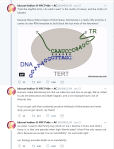
this worked well. like, really well. i have made an annotated version of some of their results:
so in conclusion: this is a really cool paper, and not only did it show that it could be done, but they actually identified a ton of genes and transcription factors that could be modified to make replacement of a plant cell wall possible by other people.
this is a huge generalization, of course- they have way more data in the paper here if y’all wanna see it for yourselves– but overall??? this technology could be really big in increasing the viability and efficiency in biofuels and sustainable biochemicals to be used in stuff like cosmetics, fabrics, plastics, etc.
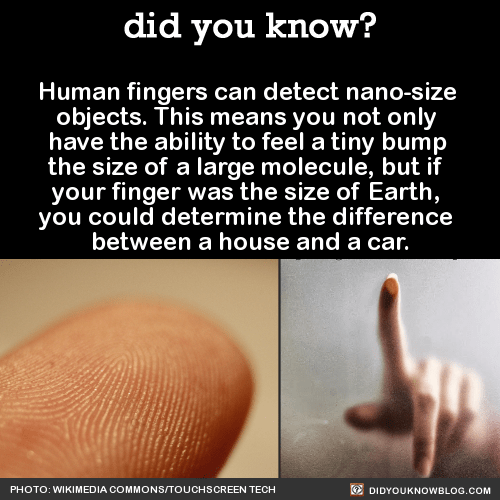
Human fingers can detect nano-size
objects. This means you not only
have the ability to feel a tiny bump
the size of a large molecule, but if
your finger was the size of Earth,
you could determine the difference
between a house and a car. Source
OH MY GOD we’ve got the FIRST EVER actual live footage of a gulper eel!!!
All previous videos have been of dead specimens floating around in tanks.
Nobody ever knew until now that they might float around with their mouth inflated like a goofy balloon like this.
It starts to “billow” mid-way through the video because of the deep sea rover’s jet stream and it puts up with that for quite a while before it finally gets too annoyed.
wait, how does this work with all those giant prehistoric bugs (scorpions and dragonflies and stuff) that were giant in the time of the dinosaurs or whatever. Is it just that they were species that never needed to molt or is there some other reason why this wasn’t an issue for them?
I don’t think insects molt. I don’t know if Scorpions do.
Limitations of oxygen metabolism are different when amount of oxygen is different.
That makes sense
To answer the original question more fully:
On earth, water tends to have a wider range of possible oxygen concentrations than air (mostly because gas is more immediately turbulent, whereas liquids are waaay less immediately turbulent (but technically both are still fundamentally turbulent, unless of the super variety (but I mean come on))). If that’s indeed a major thing constraining lobster size, there would be places small lobsters can go that old lobsters can’t, so maybe someone could look for evidence of that. The maximum size would then be determined by the accessible environmental maximum of oxygen concentration, which could be crazy high in some places, idano. On land, the species size maximum is generally set by much harder limits related to oxygenation and circulation physics stuff. When submerged, the wateriest subsets of land-biology anatomy lose many of the gravitation/bouyancy-related pressures they’ve had to contend with since first leaving the water (in the evolutionary sense). This is also why human legs swell up shrink [edit: herpderp] for a while when we first inhabit microgravity.
The size distribution of water-animals-that-didn’t-leave-for-a-while-and-then-return-with-fucking-upwards-facing-nostrils-on-their-backs will have a more apparent per-species variance than we’re used to seeing on land. Robert Wadlow was only about me-and-a-half along the longest dimension, and his heart gave out pretty early. So, like, fish and crustaceans and cephalopods and reptiles and stuff, but not mammals. Whales can be big, but they still have a hard in-vivo developmental upper bound on size from the doggo days.
it’s time to talk about a weird animal again here at bunjywunjy dot tumblr dot com (my house), and what better way to begin the new year than with an inspirational survivor to motivate us all with its sheer bullheaded tenacity?
you see, this animal has been around a very, very, very, VERY long time.
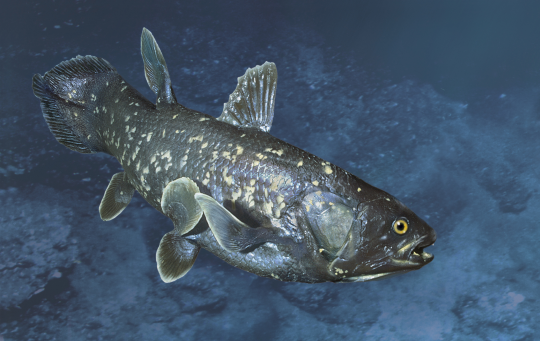
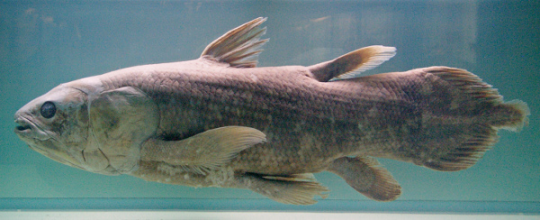
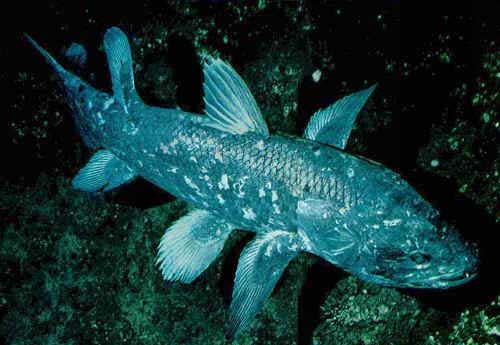
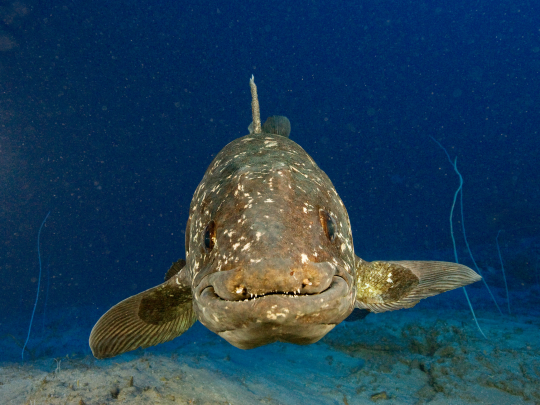
it’s called the Coelacanth, and it’s your grandma.
SEE-la-kanth. say it right sonny, my ears aren’t what they used to be
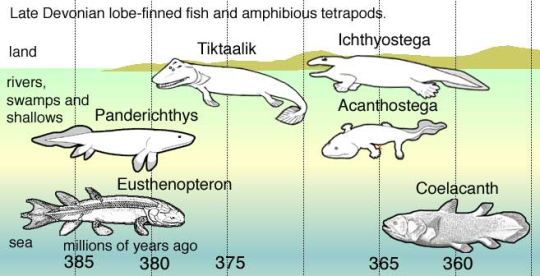
Coelacanths are the oldest form of lobe-finned fishes on the planet. their relatives first appeared 400 million years ago, and immediately made themselves famous by being the very first vertebrates to wiggle onto dry land. (they immediately wiggled right the fuck back into the water, as they had forgotten to evolve lungs first)
these fishes later evolved those weirdly buff fins into actual legs and developed into the first true land animals, though tragically they lack the Coelacanth’s roguish sense of style.
there’s a lot of stumpy little legs in this picture
while these lobe-finned fish did go on to become literally all land-dwelling vertebrates ever INCLUDING YOU, the Coelacanth was content to retain its fishy shape and continue on as it always had. for 400 fucking million years.
they probably barely even noticed all those major extinction events. meteor who?
it’s coelaCAN, not coelaCAN’T.
today, Coelacanths are still more closely related to you than they are to most other fish. think of it as the weird cousin that never gets invited to the mammal family reunion.
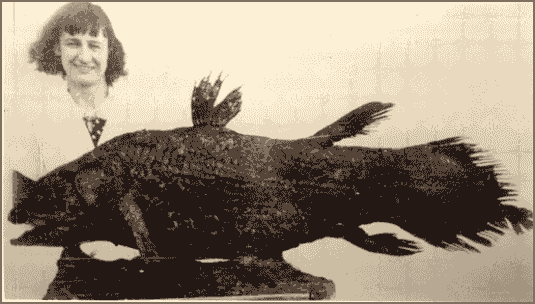
the Coelacanth’s relationship to land vertebrates has long been known from fossils, but Science believed it had gone extinct sometime in the Cretaceous period more than 60 million years ago. so imagine Science’s surprise when a live Coelacanth was pulled up by a fishing trawler in 1938, off the coast of South Africa.
surpriiiiiiise! bet you thought you’d seen the last of me
this makes them the first ever example of a Lazarus Taxon (which is an absolutely badass phrase that would make a damn good name for a rock band), meaning it’s an evolutionary line we thought was extinct but they lived, bitch.
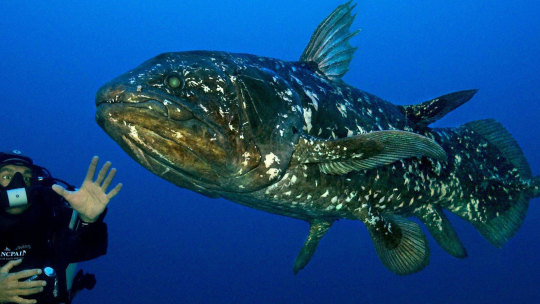
today, the Coelacanth is known to live in the Indian and South African oceans, where they thrive in deep water far away from the prying eyes of their nosy hairless ape relatives.
they are mostly active at night and can grow to be 6 and a half feet long, and live more than 60 years. they don’t have much personality, but BOY are they tenacious.
I make up for it with my stunning good looks
Coelacanths mostly drift with the current, eating whatever happens to pass by that’s smaller than they are. this just goes to show that laziness does pay off in the long run!
it’s a valid survival strategy, MOM.
Coelacanths don’t have many natural predators, as they taste completely disgusting. sharks are pretty much the only predator who will give it a try, but sharks also eat outboard motors and license plates so that’s really not saying much.
all that aside, these ancient fish can motivate us to face the challenges of the new year. just remember, if a weird fish with demi-legs can survive for 400 million years on the benefits of laziness and just being kind of weird and disgusting, so can you!
actually, that’s an effect called fasciation, and it’s relatively common in the world of plant mutations! it’s characterized by the accidental fusing together of tissues on the stem/organ in question, which can lead to the weird funky/siamese twin flowers you see in the post. more specifically, it happens when the hormones in a plant’s growing tip (the apical meristem, for those plant physiology nerds out there) get messed up for whatever reason and the plant gets confused on what to separate, which results in a ‘crested’ flattened/fused organ. for example in certain plant illnesses it’s directly caused by a bacterial infection; the hormones secreted by the bacteria living in the growing tip mess up the plant’s chemical signaling and cause the fusing effect. it can also happen through all sorts of stuff, including viral, chemical, fungal, and genetic causes.
i’ve seen three plants in my life like that: two were dandelions living by the side of a parking lot at my high school, and one was a branch of a bush that my plant pathology professor brought in to show us. it was on a plant in his backyard, and it had become infected with a bacterial infection that’s known for causing it. he was pretty excited lmao
fasciation happens like…in a SHITLOAD of plants, as long as they’re vascular (meaning not mosses, basically), which makes sense, because the mutation needs a solid stem structure to happen. here’s a fasciated palm!
and a fasciated rose! (no flowers on this one, although i think its really interesting that the plant still managed to make some thorns, if a bit tumultuously):
and of course, gotta have a saguaro cactus! apparently this one lives happily in a botanical park in phoenix, arizona. good for her, out living her best life. shown here next to a normal cactus of the same species.
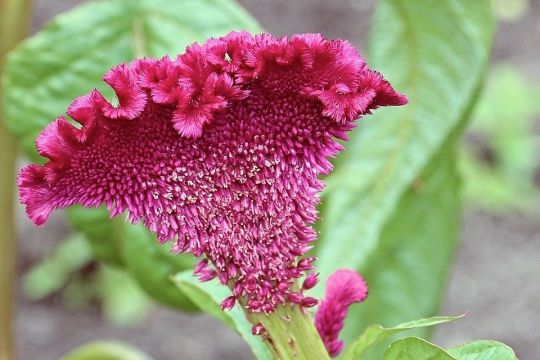
EXTRA fun fact, you may have seen THIS bad boy at ur local greenhouse, called Celosia argentea var. cristata, or ‘cockscomb celosia’ for short:
well guess what it is??? a fasciated version of Celosia argentea grown commercially specifically for its rad ass appearance!! the normal, unmutated plant looks like this:
seeing the two side by side makes it really easy to see how the plant could have messed them up just by failing to separate the flower stems right.
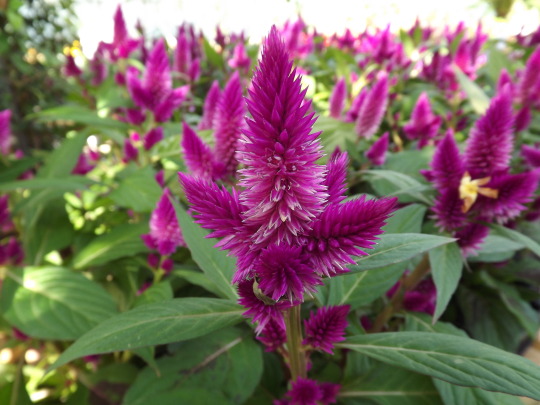
side note: these are not to be confused with the other variety of this plant, Celosia argentea var. plumosa, which is also popular in north american greenhouses for their funky little floofs (this pic shows a few different available colors, some of which the fasciated version are also grown in):
so in short…. those pics are real. plants just be fucked up like that.
Yay fasciation! Here are my weird fasciated rudbeckia hirta. Someone in a gardening group told me that rudbeckia hirta will fasciate if you so much as look at them wrong, so I was relieved that it wasn’t something to worry about.












 Time's Vengeance