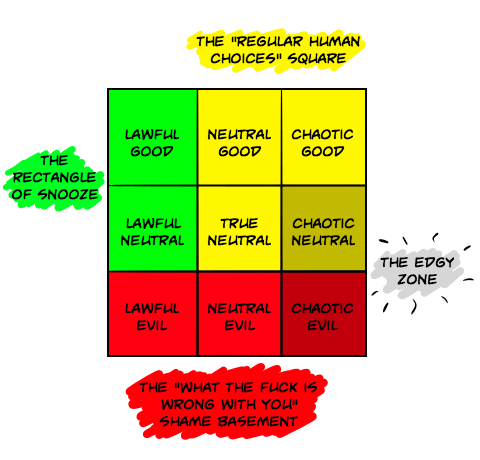
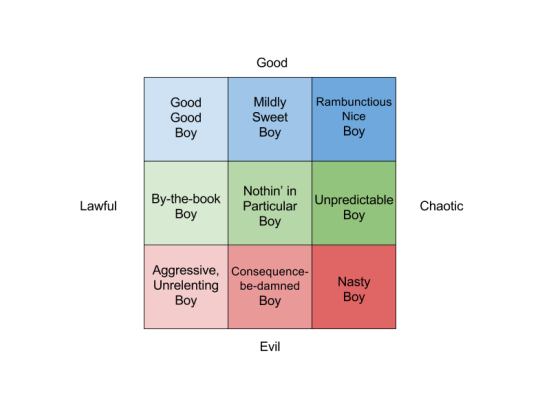
can someone explain the alignment chart for me but in like, the simplest wording possible lmao
lawful good: i want to do the right thing, and following society’s rules is the best way to do that
neutral good: i want to do what’s right, and i’m willing to bend or break the rules as long as no one gets hurt
chaotic good: i’m willing to do whatever it takes as long as it’s to do the right thing
lawful neutral: following the rules of society is the most important thing, and that matters more to me than doing what’s right
true neutral: i just want myself and the people i care about to be happy
chaotic neutral: i want my freedom, and i don’t care what i have to do to keep it
lawful evil: to impede the protagonists (in whatever evil way) is my primary goal, but i follow my own code of morals even when it’s inconvenient
neutral evil: to impede the protagonists (in whatever evil way) is the my primary goal, and while i’ll do what it takes to achieve it, i also won’t go out of my way to do unnecessary damage
chaotic evil: i relish in destruction and want to do as much damage as possible while i try to achieve my primary goal
Every single one. Like maybe there are some nts but only like one percent.
Evidence:
– it is a social norm to not make eye contact unless you are going to battle
– most trainers specialize in one type aka special interests
– no small talk. It is acceptable to introduce yourself by talking about whatever the fuck is in your mind and then going straight into a battle
– speaking of which, that youngster that says shorts are “comfy and easy to wear” totally has sensory issues that make him hate jeans
– random ass npcs will infodump you on miscellaneous aspects of the game. That o-pin guy in x/y totally has o-pins as a special interest
– all the player characters are partially nonverbal, they can usually only say “yes” and “no”, and they use scripts to order their pokemon in battle (names of moves and stuff like “the foe is weak! Get ‘em (pokemon name)!” No one finds anything notable about this or anything wrong with it
– the reason battling is turn-based is because many/most people have slow processing time and it’s considered honorable to respect this and allow your opponent to time to think
– the emphasis on collecting/trading and how it’s such a common hobby in that world.
– Satoshi Tajiri, the creator of pokemon, is autistic
– I’m sure there’s other evidence I’m forgetting
But basically this is canon and no one can convince me otherwise
Palmer’s “I thought you’d be taller” comment to John would be a million times funnier if Sam was still alive, because the moment Blue Team rolled up to the Infinity she’d have to watch an 8-foot tall Spartan barrelling down the bridge to hug his friend in open horror
What’s a player to a god, what’s a god to a DM, what’s a DM to a nat 20
this is funny but I’m going to be a Joke Ruiner here in hopes that this might be useful to anybody looking to run a D&d game sometime for the first time.
A natural 20 always ‘succeeds’ but does not always do what the player intended to do. If a player attempts to do something Impossible, then a Natural 20 cannot make it possible, instead, have the Outcome of their Attempt be helpful in an obvious way, without being necessarily a magical Super thing. Greg the ranger attempts to climb an 80 foot smooth marble wall with no handholds? Greg is level two? Greg does not climb that wall with a Natural 20, however, while looking for good handholds Greg spies an important clue reflected in the mirror-like surface of the wall, perhaps finding a secret catch to open a hidden door in the wall granting the party entrance to the dungeon?
Even though Greg didn’t search for the door, his incredible Luck granted him the opportunity to succeed anyways. Because that’s what a Natural 20 is. It’s Luck. A lucky swing catches an opponent off guard, even if they’re a seasoned fighter. No amount of luck will allow Susan the 1st level barbarian to shoot the God of War in the eye, but if she is Lucky enough, then he’ll be amused and impressed by her brash valor, and grant her a boon or a gift, rather than be insulted by her attack.
Keep in mind that a Natural 20 should align with what is best for the player, not necessarily what the player wants. If a player rolls a 20 while attempting to do something you know will end badly for them? Take advantage of your knowledge and have their roll instead indicate that not only does their attempt fail, it does so in a way that alerts the player to the danger of their attempt.
For example, they try to shoot a guard under the assumption he’s alone and it will be a sneaky quiet attack? Have the shot miss in such a way that the guard tells his friends just around the corner to “knock off all that racket, some of us still have jobs to do tonight!”
This kind of thing helps create a believable, consistent world for your players. Something that has rules and laws of physics of it’s own, even if those physics are a bit more fast and loose with thermodynamics than ours are. If a Natural 20 Always Works, then the world quickly loses credibility, because in that world, not only can literally Anything Happen, it has a 5% chance to do so All the Time
A world like that doesn’t really make much sense, and wouldn’t look at all like our world, and is therefore really hard for players to get attached to.
This is really good. I’d just like to add that you also have the option of just saying “That’s not going to work.” So many tales of DM woe could be averted by just being aware that the DM can not let the players roll dice in the first place.
 Time's Vengeance